
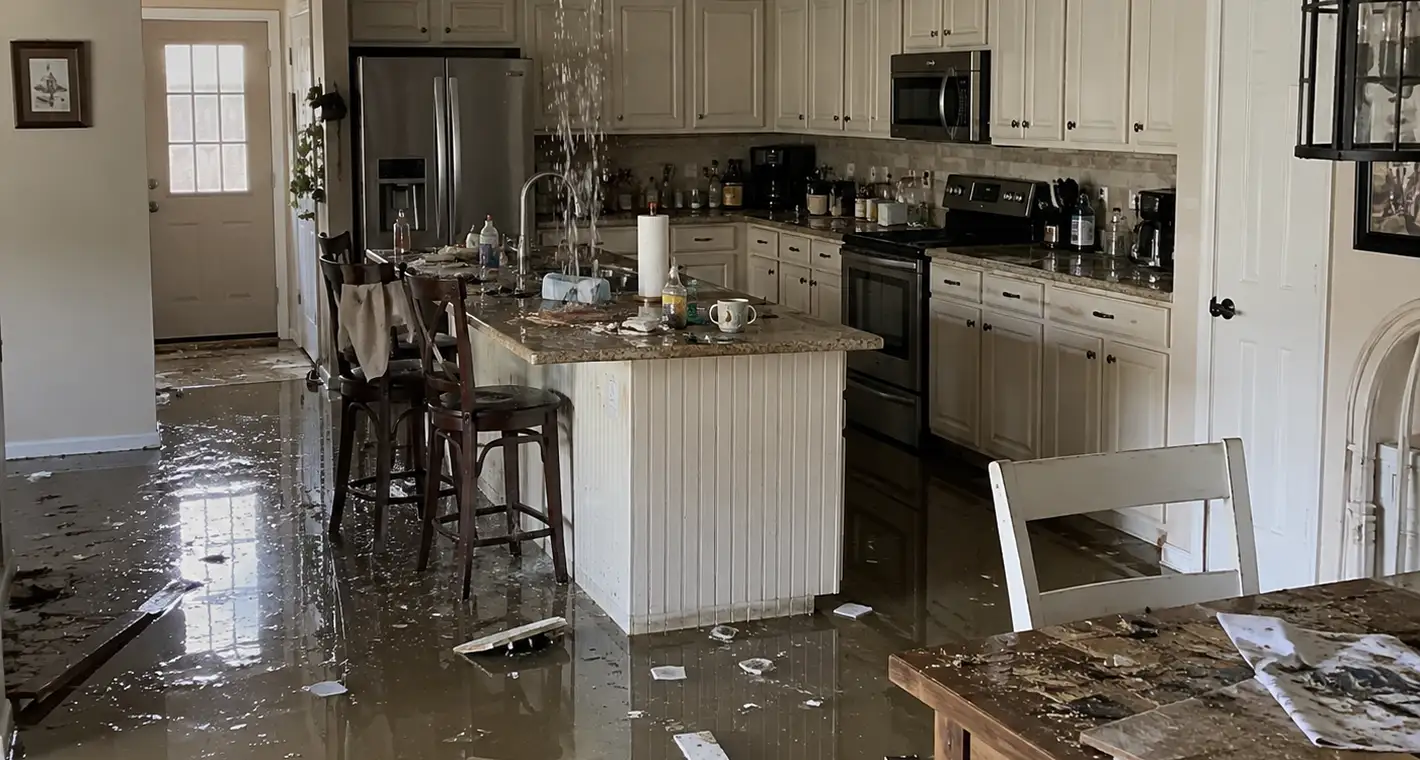
Water damage in Lake Sherwood
Lake Sherwood sits at the southern rim of the valley, in Hidden Valley, where a reservoir is held in a fold of the Santa Monica Mountains. Around six hundred and sixty residences stand on the slopes above the water, reached along Potrero Road rather than from the freeway. Custom houses on large, steep parcels rather than tract construction, built over several decades from the 1980s onward, with long private drives and retaining structures holding many of the pads in place.
Those two facts shape most of the losses that happen in Lake Sherwood. Where a house sits and what its plumbing was built for decide how water gets in and where it travels afterwards.
Before help arrives
- Shut the water off at the fixture or the main if you can reach it safely.
- Keep out of any room where water has reached outlets, cords, or the electrical panel.
- Lift furniture off wet carpet and move what you can to a dry floor.
- Photograph the damage and the failure point before anything is moved.
- Do not use a household vacuum to pick up standing water.
Common causes in Lake Sherwood
Slopes the 2018 fire burned through
The Woolsey Fire ran through this part of the mountains in November 2018 and stripped the ground above the lake. Burned slopes shed water instead of taking it in for several seasons, and on gradients this steep the runoff arrives quickly and loaded with soil and ash. For houses set into a slope that means sediment against an uphill wall and into drains sized for rain.
One road in and out after a storm
The community is reached by a single canyon route, and a storm that puts debris or water across it affects everyone behind it at once. That matters for a water loss because the variable is not distance but whether the approach is open, and a valley-wide storm loads every provider in the corridor on the same day. Calling early during a storm is worth more here than anywhere else in the valley.
Retaining walls and downslope drainage
Pads on gradients this steep are held by retaining structures with drainage built in behind them, and that drainage is out of sight from the day it is finished. When it silts up, water collects behind the wall rather than passing through, and the ground stays loaded against the structure it is holding. Indoors it shows as persistent damp at the base of an uphill wall that does not respond to drying.
Houses that stand empty between visits
A share of the properties here are not occupied continuously, and that changes the arithmetic of every failure. A supply connector that lets go in an occupied house is found within minutes; the same failure in an empty one runs until somebody arrives. Water under pressure for days rather than minutes reaches framing, insulation and the floor structure throughout.
Drying a Lake Sherwood home
Access shapes the work here more than construction does. Houses stand on steep parcels at the end of long private drives, and equipment has to be carried the last stretch on foot on many of them. Because the loss is often found late in a house that is not occupied continuously, the wet area is usually larger on arrival.
The sequence itself does not change from house to house: extraction first, then air movers and dehumidifiers working together, with moisture readings logged each day until the affected materials match the dry baseline for that building. It is described in full on the water extraction and drying page.
Services available in Lake Sherwood
- Water Extraction & DryingStanding water removal and controlled structural drying under moisture readings.
- Slab Leak DamageWater surfacing through a slab-on-grade foundation, located and dried out.
- Sewage CleanupContaminated water handled with containment, removal and cleaning.
- Mold RemediationGrowth that established after water sat longer than it should have.
- Burst pipe and supply line cleanup
- Water heater and appliance leak cleanup
- Ceiling and drywall water damage
- Moisture inspection and mapping
Areas covered in Lake Sherwood
Providers cover Lake Sherwood and the surrounding area, including Lake Sherwood shoreline, Hidden Valley, Potrero Road, Sherwood Country Club and Stafford Canyon.
ZIP codes: 91361.
Frequently Asked Questions
- Will my homeowners insurance cover water damage?
- It depends on the cause rather than the damage. Policies commonly cover sudden and accidental events such as a burst supply line or a failed water heater. Damage that developed gradually from a long-standing leak, and damage from surface flooding, are usually handled differently or excluded. Photograph everything before it is moved, keep any failed part, and report the loss promptly.
- Should I turn off the electricity?
- If water has reached outlets, cords, appliances or the panel itself, treat the area as unsafe. Shut off the breaker only if you can reach the panel without standing in water and without touching anything wet. If you cannot, leave the area and have the utility or an electrician handle it.
- The house sits empty for stretches. What is worth doing before leaving it?
- Close the main supply valve if the property allows it, which removes the possibility of a pressurised failure running unattended. Where that is not practical, a leak detection device on the main line that shuts the water off on its own is the next option. Beyond that, check the connectors behind the washing machine, under sinks and at the water heater before each departure.
- Damp keeps returning at the base of one wall after it has been dried. Why?
- Because the source outside has not been dealt with. On a slope, the drainage behind a retaining wall or the swale above the pad is what keeps ground water away from the structure, and once either silts up the soil against that wall stays loaded. Drying the inside removes the moisture that is there but not the supply, so readings climb again within days. The fix is outside, and the drying should follow it.
- Should the drying equipment run while nobody is at the house?
- It normally does, and that is the usual arrangement on properties not occupied continuously. The equipment is designed to run unattended and the drying only works if it runs without interruption, so stopping it between visits extends the job considerably. What matters is that the provider has agreed access for monitoring.
- How much does the drive up Potrero Road affect getting help during a storm?
- It is the main variable here. Providers cover this community from the valley below, and in ordinary conditions the drive is a matter of minutes rather than a barrier. During a heavy storm it becomes the deciding factor, because a single canyon route can be blocked by debris while every provider in the corridor is already committed elsewhere. That is the argument for calling as soon as water is spreading.