
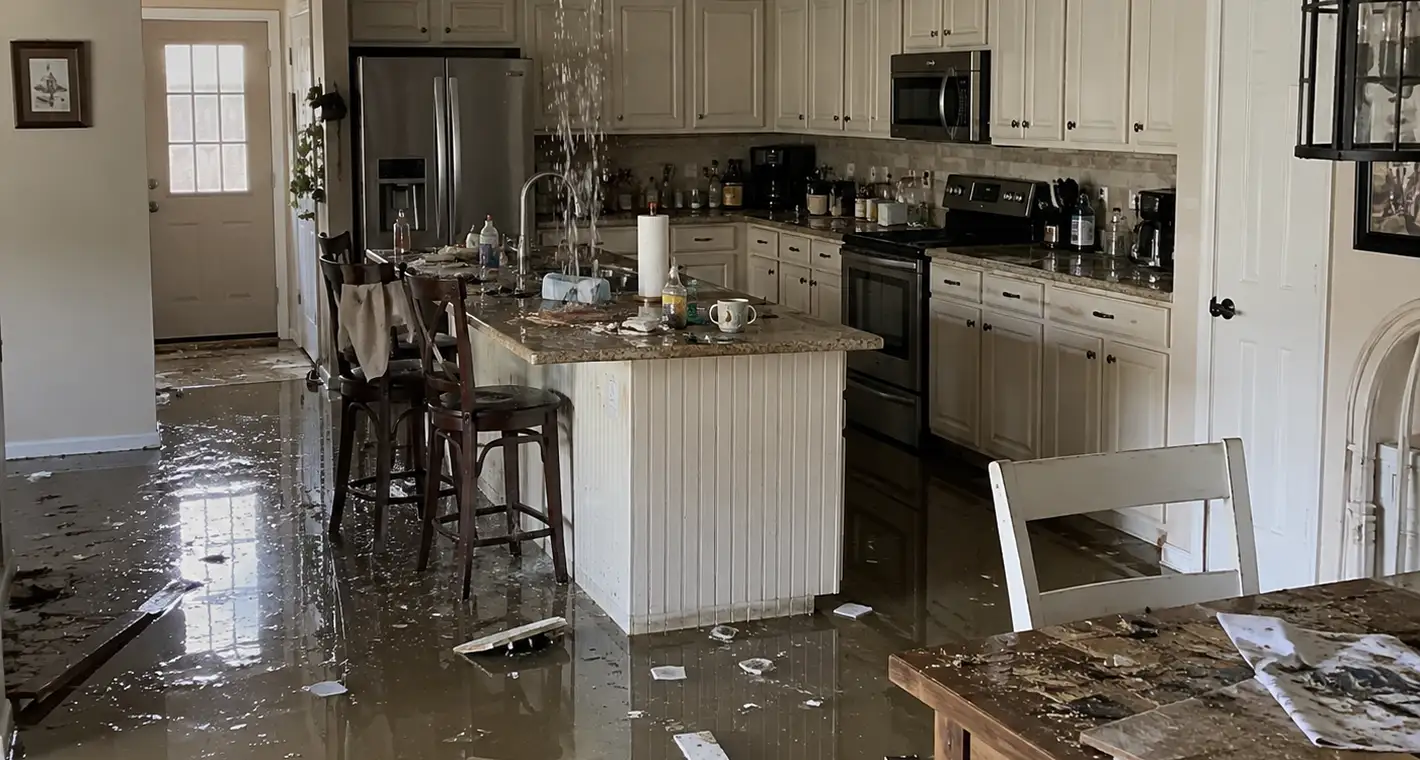
Water damage in Thousand Oaks
Thousand Oaks sits in the middle of the Conejo Valley, between the Santa Monica Mountains and the Simi Hills, with Arroyo Conejo draining west through Hill Canyon. The ground changes across town: volcanic rock under the western half, marine shale under much of the east. Laid out as a master plan in the mid-1950s and incorporated in 1964. Single-storey ranch houses on slab from the 1960s and 1970s make up the core, with later tracts stepped into the hillsides on graded pads.
Those two facts shape most of the losses that happen in Thousand Oaks. Where a house sits and what its plumbing was built for decide how water gets in and where it travels afterwards.
Before help arrives
- Shut the water off at the fixture or the main if you can reach it safely.
- Keep out of any room where water has reached outlets, cords, or the electrical panel.
- Lift furniture off wet carpet and move what you can to a dry floor.
- Photograph the damage and the failure point before anything is moved.
- Do not use a household vacuum to pick up standing water.
Common causes in Thousand Oaks
Copper running under sixty-year-old slabs
The tracts that built this city went in with copper supply lines buried in or under the slab, now well past fifty years in the ground. Copper of that age fails as a pinhole rather than a burst, so water arrives slowly and beneath the floor. The signs are a warm patch underfoot, a meter that keeps turning with every fixture closed, and damp carpet with nothing above it.
Pads cut and filled into the hillsides
Hillside tracts were built by cutting a level pad out of the slope and using the spoil to build out the other half. Native ground and engineered fill do not settle at the same rate, and over decades that difference works on the slab above. What it does to plumbing is shear it slowly at the joints.
Static pressure at the bottom of a zone
The valley climbs several hundred feet across town, and a water system built for that relief runs pressure zones that leave houses at the bottom of one carrying far more pressure than those above. California plumbing code calls for a regulator past eighty psi. That regulator is a wearing part, and when it drifts open the house it protects starts failing hoses and connectors.
A whole wet season in a handful of storms
Around fifteen inches of rain fall here in an average year, and nearly all of it between November and March. That is not a small amount of water, it is the same amount delivered in fewer, harder events. Gutters, area drains and the culverted storm system under the boulevard handle steady rain and struggle with an atmospheric river.
Drying a Thousand Oaks home
Slab construction sets the pattern in every house here. There is no lower level for water to collect in, so it travels sideways under flooring, and the garage is usually poured continuous with the living space. Air handlers and their condensate lines sit in the attic, so many losses arrive downward through a ceiling.
The sequence itself does not change from house to house: extraction first, then air movers and dehumidifiers working together, with moisture readings logged each day until the affected materials match the dry baseline for that building. It is described in full on the water extraction and drying page.
Services available in Thousand Oaks
- Water Extraction & DryingStanding water removal and controlled structural drying under moisture readings.
- Slab Leak DamageWater surfacing through a slab-on-grade foundation, located and dried out.
- Sewage CleanupContaminated water handled with containment, removal and cleaning.
- Mold RemediationGrowth that established after water sat longer than it should have.
- Burst pipe and supply line cleanup
- Water heater and appliance leak cleanup
- Ceiling and drywall water damage
- Moisture inspection and mapping
Areas covered in Thousand Oaks
Providers cover Thousand Oaks and the surrounding area, including Wildwood, Lynn Ranch, Conejo Oaks, Sunset Hills, North Ranch, Los Robles and Thousand Oaks Boulevard corridor.
ZIP codes: 91360, 91362, 91358.
Frequently Asked Questions
- Will my homeowners insurance cover water damage?
- It depends on the cause rather than the damage. Policies commonly cover sudden and accidental events such as a burst supply line or a failed water heater. Damage that developed gradually from a long-standing leak, and damage from surface flooding, are usually handled differently or excluded. Photograph everything before it is moved, keep any failed part, and report the loss promptly.
- Should I turn off the electricity?
- If water has reached outlets, cords, appliances or the panel itself, treat the area as unsafe. Shut off the breaker only if you can reach the panel without standing in water and without touching anything wet. If you cannot, leave the area and have the utility or an electrician handle it.
- The floor in one room feels warm in a house with no floor heating. What does that mean?
- A warm patch on a slab floor usually means a hot water line under it is losing water. The concrete conducts heat outward from the leak, so the warm area is wider than the failure and does not tell you where the pipe is. Shut every fixture and watch the water meter: if it keeps moving, water is leaving the system somewhere it should not.
- Water stained the ceiling in summer with no rain at all. Where is it coming from?
- In a house with the air handler in the attic, the usual answer is condensate. The unit produces water through cooling season and drains it across the attic, and when that line blocks the pan overflows into the ceiling below. Because it happens in dry weather nobody connects it to plumbing, and the insulation above is often wet for weeks.
- My house is on a hillside pad. Should the winter rain worry me?
- Not on its own, but the drainage built with the pad is worth checking before each wet season. Hillside lots rely on graded swales behind the house and terrace drains partway up the slope, and both fill with leaves and soil over the years. When they stop carrying water around the house it runs along the uphill wall instead.
- Everyone here talks about slab leaks. Is that real or is it a sales pitch?
- It is real, and the housing stock explains why. A large share of Thousand Oaks was built between 1960 and 1980 on slab with copper supply lines run through or beneath the concrete, and copper of that age develops pinholes. What is worth pushing back on is a diagnosis without evidence: it should be demonstrated with a meter test and located before anyone opens concrete.