
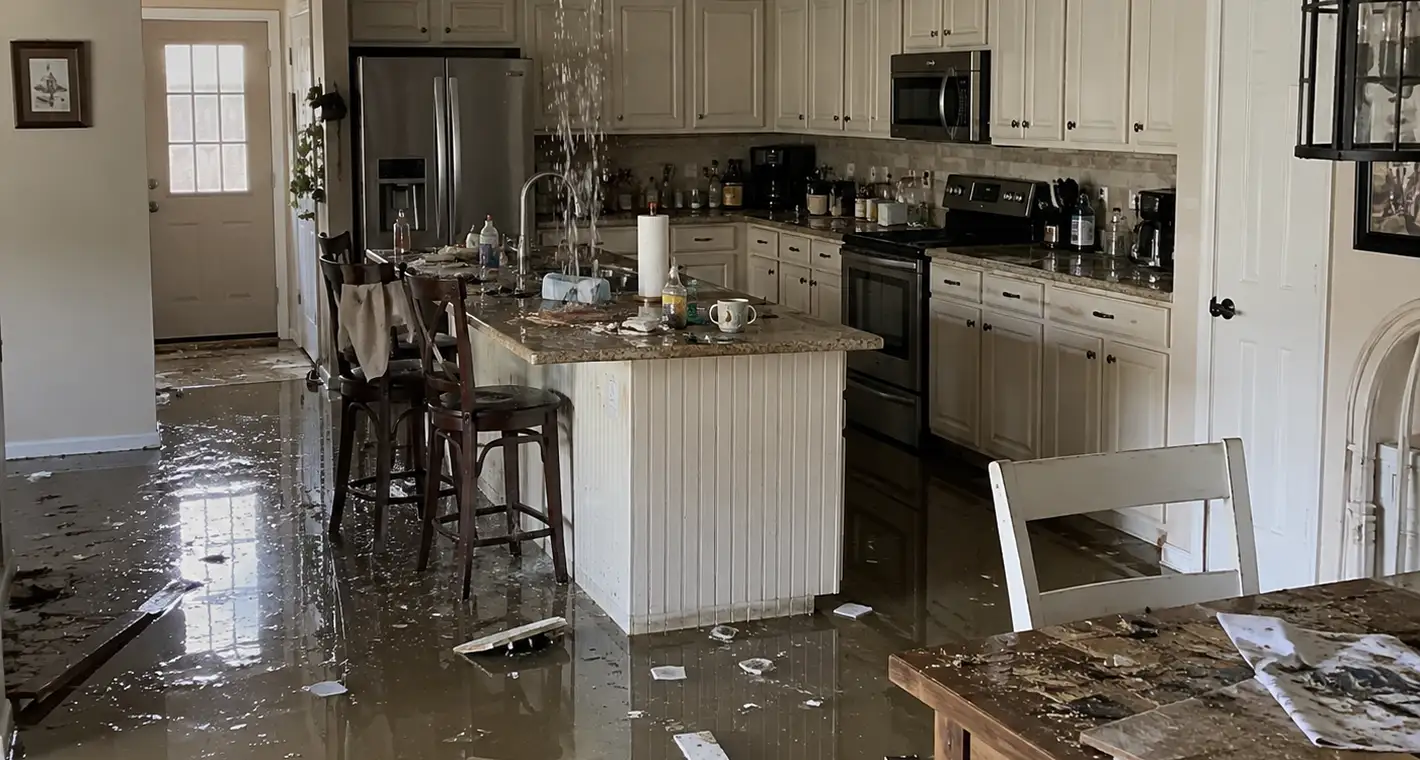
Water damage in Casa Conejo
Casa Conejo is a small unincorporated pocket inside Newbury Park, bounded by Old Conejo Road and the freeway on the north and Borchard Road on the south. It sits on flat valley floor rather than on any of the graded hillside pads around it. The first planned community built in Newbury Park, started in 1960 on land that had been part of Rancho El Conejo. Annexation was put to its voters in the 1980s and rejected, so it stays a county island inside Newbury Park and holds some of the oldest tract slabs in the valley.
Those two facts shape most of the losses that happen in Casa Conejo. Where a house sits and what its plumbing was built for decide how water gets in and where it travels afterwards.
Before help arrives
- Shut the water off at the fixture or the main if you can reach it safely.
- Keep out of any room where water has reached outlets, cords, or the electrical panel.
- Lift furniture off wet carpet and move what you can to a dry floor.
- Photograph the damage and the failure point before anything is moved.
- Do not use a household vacuum to pick up standing water.
Common causes in Casa Conejo
The oldest tract plumbing in the valley
Houses here went up around 1960, which puts their original supply lines at roughly sixty-five years in the ground. Copper of that age under a slab pinholes as a matter of course, and on plans this compact the failure is rarely far from a room that matters. With every fixture closed and the irrigation off, a meter that keeps turning means water is leaving the system beneath the floor.
Original drain lines under the slab
Waste lines of this vintage are cast iron indoors and clay to the street, and both fail by age rather than by misuse. Cast iron corrodes from the inside until the base of the pipe opens; clay laterals separate at the joints and take roots. Either one brings contaminated water back up through the drain closest to the floor.
Grade that has climbed against the house
Sixty-five years of added planters, raised beds, patio slabs and replaced walkways tend to lift the ground around a house without anyone deciding to do it. Slab construction was set close to grade to begin with, so the margin disappears. Once the soil outside sits at the level of the slab edge, storm water standing along a wall soaks through to the sill plate.
A garage on the same pour as the house
The water heater and the laundry connections in these plans stand on the garage slab, poured continuous with the living space and without a step between them. A tank that fails there releases onto a floor running directly into the hallway. There is normally no drain pan and no floor drain, so the first thing that stops the water is carpet.
Drying a Casa Conejo home
These are compact single-storey houses on a small footprint, so a loss reaches a large share of the floor plan quickly. There is no upper floor to buy time and no hallway of any length to slow the spread. The original plans also put the garage on the same pour with no threshold, so equipment set for the living space alone leaves the wettest concrete out of the plan.
The sequence itself does not change from house to house: extraction first, then air movers and dehumidifiers working together, with moisture readings logged each day until the affected materials match the dry baseline for that building. It is described in full on the water extraction and drying page.
Services available in Casa Conejo
- Water Extraction & DryingStanding water removal and controlled structural drying under moisture readings.
- Slab Leak DamageWater surfacing through a slab-on-grade foundation, located and dried out.
- Sewage CleanupContaminated water handled with containment, removal and cleaning.
- Mold RemediationGrowth that established after water sat longer than it should have.
- Burst pipe and supply line cleanup
- Water heater and appliance leak cleanup
- Ceiling and drywall water damage
- Moisture inspection and mapping
Areas covered in Casa Conejo
Providers cover Casa Conejo and the surrounding area, including Old Conejo Road, Borchard Road, Jenny Drive, the Sequoia school area and the US-101 frontage.
ZIP codes: 91320.
Frequently Asked Questions
- Will my homeowners insurance cover water damage?
- It depends on the cause rather than the damage. Policies commonly cover sudden and accidental events such as a burst supply line or a failed water heater. Damage that developed gradually from a long-standing leak, and damage from surface flooding, are usually handled differently or excluded. Photograph everything before it is moved, keep any failed part, and report the loss promptly.
- Should I turn off the electricity?
- If water has reached outlets, cords, appliances or the panel itself, treat the area as unsafe. Shut off the breaker only if you can reach the panel without standing in water and without touching anything wet. If you cannot, leave the area and have the utility or an electrician handle it.
- Sewage came up through the shower rather than a toilet. What does that indicate?
- A blockage downstream of both, in the main line under the slab or in the lateral out to the street. Waste backs up to the drain nearest the floor, which is why a shower or a laundry standpipe fills before a toilet overflows. On drain lines of this age the usual cause is root intrusion at a clay joint or a corroded cast iron section.
- Water is coming up where the floor meets the wall. Is that rain or plumbing?
- Both look the same at the surface, and the difference is timing. Water tied to storms and confined to walls facing where the ground is highest points to grade and drainage outside. Water that appears in dry weather, or persists between storms, points to a line under the slab. A meter test with all fixtures closed separates them within an hour.
- Is it worth replumbing a house of this age rather than repairing each leak?
- It is worth asking once a second failure occurs, because the answer is about the rest of the system rather than the pipe that failed. A single pinhole in sixty-five-year-old copper says the material has reached the stage where it fails; a second confirms it. Rerouting new lines overhead through the attic avoids opening the slab again, but that is a decision for a licenced plumber.
- Being unincorporated county rather than city, does anything work differently here?
- Not for the emergency work itself. Providers covering Newbury Park and Thousand Oaks reach this pocket on the same runs and nothing about extraction or drying changes at the boundary. Where it does matter is afterwards: permits and inspections for structural repairs go through Ventura County rather than the city.