
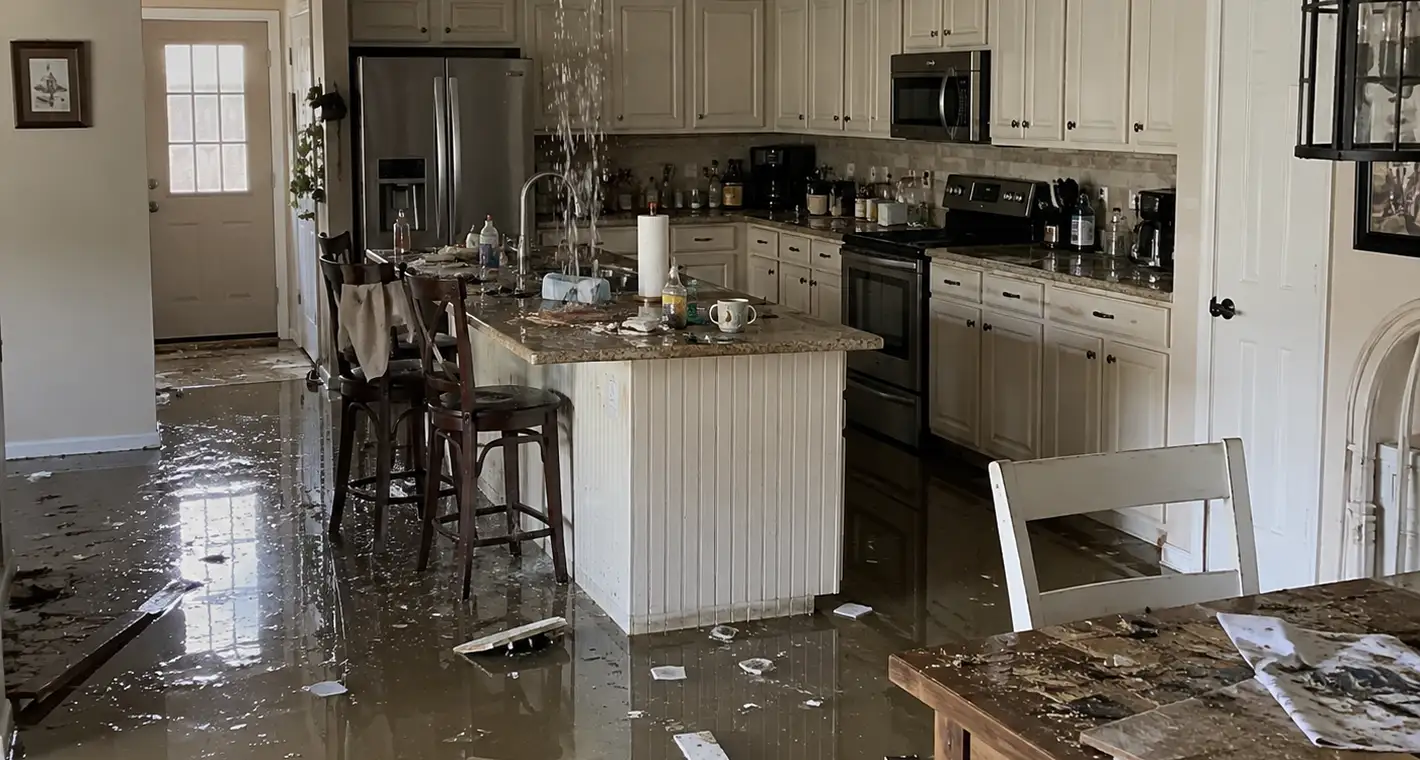
Water damage in Agoura Hills
Agoura Hills lies along the freeway on the eastern side of the valley, under Ladyface Mountain, at the head of the drainage running south toward Malibu Creek. Medea Creek and Lindero Canyon carry that water through the middle of the city. A split city in building terms: Old Agoura on the north side keeps larger parcels, equestrian properties and some raised floors, while the tracts south of the freeway are conventional slab construction from the 1970s and 1980s.
Those two facts shape most of the losses that happen in Agoura Hills. Where a house sits and what its plumbing was built for decide how water gets in and where it travels afterwards.
Before help arrives
- Shut the water off at the fixture or the main if you can reach it safely.
- Keep out of any room where water has reached outlets, cords, or the electrical panel.
- Lift furniture off wet carpet and move what you can to a dry floor.
- Photograph the damage and the failure point before anything is moved.
- Do not use a household vacuum to pick up standing water.
Common causes in Agoura Hills
Horse properties and long service runs
Parcels in Old Agoura carry barns, tack rooms, arenas and irrigation, all fed by buried lines running a long way from the house. A break partway along a run shows at neither end while the supply keeps feeding it, so the first sign is pressure dropping indoors or a bill that has climbed. On a sloping parcel that water moves toward whatever is built below it.
Medea Creek and the canyon drainages
The creek and the canyon channels through town are dry most of the year and take the whole hillside's runoff during a storm. Because the catchment above is steep and largely chaparral, the rise is quick rather than gradual, and it carries branches and gravel that block culverts and inlets.
Ground stripped by the 2018 fire
The Woolsey Fire came through this part of the corridor in November 2018 and burned slopes on both sides of the freeway. Fire-affected ground repels water for several seasons, so the first heavy storms after it produce runoff loaded with ash and soil. What arrives at a house below a burned slope is thick enough to seal the drains meant to carry it, and it leaves sediment inside the structure.
Slab tracts of the 1970s and 1980s
The tracts south of the freeway are four to five decades old on their original copper, which is the age at which supply lines under a slab begin to pinhole. Water heaters in garages on the same pour as the house are the other regular source. Neither announces itself: the slab leak shows as a warm floor or a meter that will not stop.
Drying a Agoura Hills home
Two building types in one city means two different jobs. Slab houses south of the freeway hold water at floor level and spread it sideways under flooring. Older raised-floor properties in Old Agoura let water through into the space beneath, where it is out of sight and the floor structure keeps drawing it up from below.
The sequence itself does not change from house to house: extraction first, then air movers and dehumidifiers working together, with moisture readings logged each day until the affected materials match the dry baseline for that building. It is described in full on the water extraction and drying page.
Services available in Agoura Hills
- Water Extraction & DryingStanding water removal and controlled structural drying under moisture readings.
- Slab Leak DamageWater surfacing through a slab-on-grade foundation, located and dried out.
- Sewage CleanupContaminated water handled with containment, removal and cleaning.
- Mold RemediationGrowth that established after water sat longer than it should have.
- Burst pipe and supply line cleanup
- Water heater and appliance leak cleanup
- Ceiling and drywall water damage
- Moisture inspection and mapping
Areas covered in Agoura Hills
Providers cover Agoura Hills and the surrounding area, including Old Agoura, Morrison Ranch, Liberty Canyon, Lake Lindero, Chesebro and Reyes Adobe.
ZIP codes: 91301.
Frequently Asked Questions
- Will my homeowners insurance cover water damage?
- It depends on the cause rather than the damage. Policies commonly cover sudden and accidental events such as a burst supply line or a failed water heater. Damage that developed gradually from a long-standing leak, and damage from surface flooding, are usually handled differently or excluded. Photograph everything before it is moved, keep any failed part, and report the loss promptly.
- Should I turn off the electricity?
- If water has reached outlets, cords, appliances or the panel itself, treat the area as unsafe. Shut off the breaker only if you can reach the panel without standing in water and without touching anything wet. If you cannot, leave the area and have the utility or an electrician handle it.
- A buried irrigation line has been leaking somewhere on the property. Can that reach the house?
- On a sloping parcel it can. Water leaving a buried line saturates the soil around it and then follows the ground rather than the pipe, moving downhill until something interrupts it. If the house or an outbuilding is below the break, that water arrives at the foundation edge and works in from the side. The clue is ground that stays soft in dry weather.
- How soon does mould become a concern after a water loss?
- The commonly used figure is twenty-four to forty-eight hours for growth to begin on wet organic material at normal indoor temperatures, and this valley is warm enough for most of the year that the shorter end applies. What matters more is that it starts inside a wall cavity, out of sight, well before anything is visible in the room. Drying quickly and measuring the result is what prevents it.
- What should I do in the first hour if water is spreading?
- Stop the source at the shut-off valve if you can reach it safely, then deal with electricity: if water has reached outlets, cords or the panel, treat the area as unsafe. Lift what you can off wet flooring and photograph everything before anything is moved. Do not pull up flooring or open walls yourself.
- Our house in Old Agoura has a crawl space rather than a slab. Does that change anything?
- It changes where the water goes and how long it stays. On a raised floor, water passing through the structure ends up underneath it, where nobody sees it and it does not evaporate the way it would in a room. The subfloor keeps drawing moisture up from below, so the space itself has to be entered, cleared and dried, not just the room above it.